Phosphorothioate (PS) Panels
Phosphorothioate (PS) Panels
ModDetect™ Phosphorothioate (PS) Panels provide sensitive, sequence-independent detection of PS-modified oligonucleotides across a range of analytical assays. Designed for use in biodistribution, quantification, and localization studies, these reagents help accelerate RNA therapeutic development by enabling reliable measurement of chemically modified ASOs in cells and tissues.
The Role of PS Modifications in ASO Drug Design
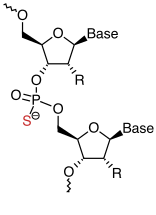
Phosphorothioate (PS) modification is an foundational first-generation modification intended to stabilize oligonucleotide therapeutics against nucleic acid degradation. While the naturally occurring phosphodiester (PO) bond is sensitive to nuclease degradation, the PS internucleosidic linkage offers enhanced resistance to exonuclease degradation. PS modification is commonly incorporated into antisense oligonucleotides (ASO), small interfering RNAs (siRNA), and other RNA modalities to improve stability. ASOs may also be configured as “gapmers”, in which multiple PS residues flank a central DNA core, while siRNA typically feature PS residues at the 5’ and 3’ termini of both sense and antisense strands.
While PS modification enhance stability, too many PS bonds can increase toxicity. Strategies have emerged to use partial PS modification, often in combination with second-generation chemistries such as 2’-MOE, 2’-OMe, 2’-Fl, or LNA to balance potency and safety.
ModDetect™ PS panels contain highly specific antibodies that detect PS bonds independent of nucleic acid sequence. These reagents enable quantitative immunoassays for biodistribution, intracellular localization, quantification, and bioanalytical characterization of PS-modified ASOs, siRNA, miRNA, aptamers, and mRNA, with as few as two non-overlapping epitopes on a PS-modified oligonucleotide needed for detection in a sandwich ELISA.
Key Applications of ModDetect™ Phosphorothioate Panels
ModDetect Anti-PS antibodies provide versatile, sequence-independent tools for analyzing PS-modified antisense oligonucleotides in preclinical studies. From precise quantification to detailed tissue biodistribution and intracellular localization, these panels generate actionable data that inform therapeutic delivery, efficacy, and optimization. The following applications highlight how ModDetect antibodies support critical decision-making throughout oligonucleotide drug development.
Explore our Poster: Detection and Quantification of PS-Modified ASO in Biological Matrices using ModDetect Panel
Highly Sensitive Quantification of PS-Modified ASOs
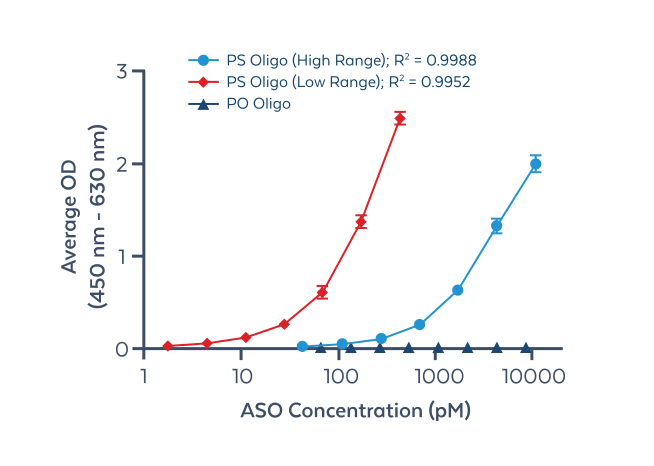
ModDetect™ Anti-PS antibodies enable reliable quantification of phosphorothioate-modified antisense oligonucleotides across a broad concentration range. Using clone PS04, standard curves demonstrated highly specific detection down to the low picomolar range, with no signal from non-modified controls. This level of sensitivity supports accurate PK/PD measurements in both discovery and preclinical studies.

Reliable Detection of PS-Modified ASOs in Tissue Biodistribution Studies
ModDetect™ Anti-PS antibodies provide specific and reproducible detection of phosphorothioate-modified antisense oligonucleotides in tissue models. In hepatocyte studies, multiple antibody clones (PS03, PS04, PS05) showed strong staining correlated with PS content, with no background in non-modified controls. This enables accurate mapping of ONT biodistribution to support delivery assessment and candidate selection during preclinical development.

Resolve Intracellular Localization Patterns of PS-Modified ASOs
ModDetect™ Anti-PS antibodies enable precise visualization of phosphorothioate-modified antisense oligonucleotides within cells, revealing their localization to endosomal compartments and cytoplasmic regions. Using clone PS05, punctate cytoplasmic staining consistent with endosomal accumulation was observed in ASO-treated cells. These results provide valuable insight into cellular uptake and trafficking, supporting the development of more effective RNA therapeutics.
Available ModDetect™ Panels and Clones
The ModDetect™ PS Panels are available in unconjugated and biotinylated formats. Individual clones are also available for separate purchase to support custom assays or specialized workflows.
| PS Panels | Format |
| ModDetect Phosphorothioate Panel | Unconjugated |
| ModDetect Phosphorothioate Biotin Panel | Biotin |